



Proposal Software for Trade Contractors: Embedding Line-Item Inventory Availability
Summary The use of proposal software enables trade contractors to make professional estimates, control prices, and make presentations…
TABLE OF CONTENTS
General contractor software aids in scheduling, budgeting, and subcontractor coordination; however, tracking material utilisation may still be a missing element. When subcontractors take materials out of the inventory on the construction site without adequate paperwork, it is hard to keep track of expenses and secure profits. This article aims to investigate ways of improving general contractors’ awareness of material utilisation without additional administrative effort.
Construction projects use only one team that sources their inventory from one place. Materials are sourced by the general contractor, brought on-site, and utilised by several subcontractors over weeks or months.
Take the example of a common situation. The construction materials, such as lumber, fasteners, insulation, and others, have been delivered to the site before the beginning of construction. Various subcontractors use these materials during the construction period. When it comes to billing and cost review, nobody knows which subcontractor used what materials, which materials have been used from inventory, and what was left over.
It is not a problem of a lack of inventory control but is directly related to job costing and the accuracy of budgeting and accounting. As material flows cannot be observed by any means, it is difficult for the contractor to know if his project has been completed within budget or where those unplanned costs originated from.
With the growing size and complexity of construction projects, the control of materials usage becomes just as important as planning and budgeting. General contractor software can help manage project information, but the material tracking process is equally important in order to ensure profitability.
Every material delivered to a project represents a cost that should be connected to the work being performed.
A construction site can never remain constant. There will always be deliveries of materials each day, as well as several subcontractors working at the same time and materials moving from storage to the work site. The lack of a system to measure the material that is used will make inventory counting very hard.
Materials such as those related to plumbing and electricity might be found in different parts of the same site. As long as several subcontractors use these materials without measuring what they are using, the inventory count will definitely be wrong from the beginning.
The problems arising from this situation are usually discovered only when the construction project is coming to an end. Budgeting will lead to some material being discovered where it should not be.
It would be easier to avoid this problem if a proper measurement were done.
Most general contractor software provides strong visibility into overall project coordination and progress.
Such abilities are beneficial in monitoring time schedules, coordination of trades, and performance management of the whole project.
The issue of visibility gets compromised, especially concerning the use of materials by subcontractors.
Most of the contractors use the spreadsheet approach, emails, handwritten information, or any other form of communication to document the use of materials. In spite of the fact that such techniques might be effective in small-scale projects, they get complicated in large-scale projects due to the involvement of several subcontractors, deliveries, and working sites.
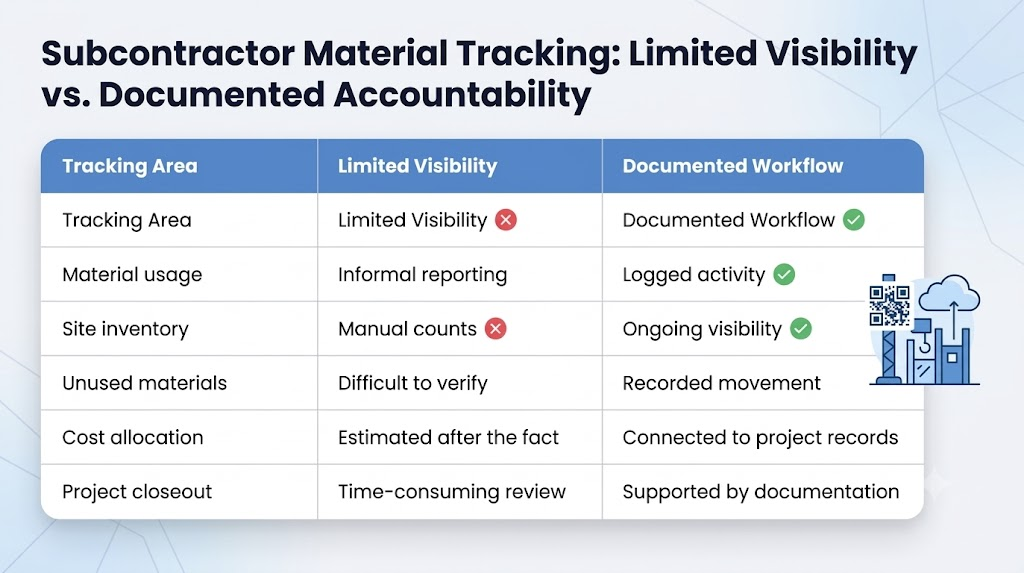
When there is no inventory management software in place, one might know that some materials have been delivered to the site, but it will be difficult to find out who used them, when they were used, and whether there are still some unused materials.
Material tracking works best when every movement is connected directly to the project record rather than being documented after the work is complete.
The objective is not to create additional paperwork for subcontractors. It serves to create a straightforward way of recording the movement of materials as the work proceeds.
For instance, when drywall is delivered to the site, the delivery is registered within the project database. Should part of the inventory be moved or assigned to a different building or subcontractor, the transfer is recorded instead of being left to memory or word of mouth.
The result will be a full accounting of the origin of the materials, how they were utilised, and what part of the project they were consumed by. Rather than spending hours trying to figure out inventory variances while reviewing the project, contractors can easily refer to an audit trail throughout the whole project.
Construction sites usually act as temporary inventory centres, thus making visibility as crucial there as in any warehouse setting.
Because projects rarely receive all materials at once, inventory is constantly changing throughout construction.
A delivery received during the framing phase may still be available weeks later, while another shipment could already be allocated to upcoming work. Inaccurate site-level visibility can result in material orders being placed merely on the basis of not finding out where the existing materials are.
A better idea of the delivery of materials, their usage, and availability is gained through material management at the site level. This improves purchasing decisions while reducing unnecessary duplicate orders and material shortages.
It also helps project managers coordinate multiple subcontractors using the same inventory without relying on manual updates throughout the day.
Project closeout becomes significantly easier when material activity has been documented from the beginning.
These documents make it easier for the contractor when reviewing finished projects, verifying the supplier’s invoice, and answering any enquiries regarding the cost of the project.
Contractors do not have to guess how much material was used after the completion of the construction process since they can go through their documentation.
It makes the whole billing process easier, and they will be confident when evaluating the performance of their project.
Build Accountability Without Slowing Down the Job
The goal of subcontractor material tracking is not to introduce additional administrative work. It is for gaining visibility on where materials are going, who will use them, and how all these costs impact the performance of the entire project.
When all material arrivals, inventory management, subcontractor usage, and documentation on projects are kept linked, contractors are better able to understand their project costs and avoid conflicts.
SilkRoad App enables contractors to link inventory visibility, job tracking, documentation, and workflow management in one system that is geared towards construction companies.


Nelia Madeira is the Co-Founder and Chief Financial Officer (CFO) of SilkRoad Trades , a construction technology company dedicated to helping specialty contractors simplify inventory management, optimize field operations, improve job costing, and increase profitability.
With more than 20 years of hands-on experience in construction operations, accounting, office management, and business...


General contractor software can assist in managing the project’s schedule, budget, subcontractors’ cooperation, documentation, and job performance. It should also offer insight into the flow of materials throughout the entire process of project execution.
Material tracking allows linking the consumption of inventory items to particular jobs and subcontractors and thus calculating their costs.
Shared inventory can be tracked by recording deliveries, documenting material movements, assigning inventory to projects, and logging material consumption throughout the construction process.
Site notes, delivery records, material usage history, inventory movement logs, and photo documentation all provide valuable information when reviewing project performance and reconciling costs during closeout.
Tracking materials used during project implementation will provide information regarding the location of materials, who accessed them, and their effect on project costs.
Subcontractors are many at the jobsite and share the same inventory; therefore, it is impossible to know the particular subcontractor who used certain materials without proper tracking of inventory.
By recording material deliveries, transfers, consumption, and leftover inventory as they occur, contractors can allocate material costs more accurately and gain better visibility into project performance.
Development

Summary The use of proposal software enables trade contractors to make professional estimates, control prices, and make presentations…
Nelia Madeira
26 Aug 2026
Development

Summary Mobile workforce management and modern HVAC contractor software facilitate the coordination of technicians, schedules, jobs, and field…
Nelia Madeira
24 Aug 2026
Development

Summary Construction Inventory Management Software links the work order, inventory allocation, warehouse inventory, and inventory consumption to active…
Nelia Madeira
23 Jul 2026
Have questions or need assistance? Our team is here to help you every step of the way.
Please enter your details to create a new account.
By contacting us, you agree to your Terms of Service and Privacy Policy
Copyright © Silkroad 2026
