


How Concrete Contractor Software Helps Reduce Material Waste
Summary The benefits that concrete contractor software provides are best realised when it integrates all aspects of material…
TABLE OF CONTENTS
Field service software solutions provide the ability for contractors to manage jobs, schedules, crews, and customer information. Not all of them take into account one crucial aspect that may result in additional expenses, complications in operation management, and a decrease in profits: returning hired equipment in a timely manner. This article aims to discuss why return tracking is sometimes neglected and how it influences contractors’ daily operations.
Rental equipment is an integral part of any trade and services business. From plate compactor to trencher, lift to a generator, or any specialised diagnostic equipment, contractors constantly use rentals to perform their tasks without having to make any significant capital expenditures.
This problem arises when the equipment reaches the worksite. Rental periods vary, the deadlines of various projects shift, and the accountability of equipment returns becomes unclear. In case you see an overdue fee on the bill for your rental or in the monthly summary of the credit card statement, you have missed the deadline several days ago or even more.
The problem is that many contractors’ rental equipment is not controlled within the system, where other job activities and deadlines are being managed. Thereby, the expenses, which could be easily avoided, accumulate from different projects. Most field service management software solutions have very good scheduling and job management features, while the deadlines of the equipment return remain to be tracked in a calendar or spreadsheet.
As businesses grow and crews manage more simultaneous projects, keeping track of multiple rental agreements becomes increasingly difficult. What begins as a simple reminder to return a machine can quickly become an operational issue when equipment moves between jobs or responsibility changes hands.
Rental costs are easy to approve but difficult to monitor once equipment enters the field.
Something that starts as an oversight ends up becoming a regular cost incurred through operations.
For example, take a hired crane that completes a job at one location but gets transferred to another place. Without documentation of this change and analysis of the hiring contract, the machinery may end up being hired much longer than necessary. This is simply because nobody noticed that the end date of the hire had already elapsed.
These situations rarely result from poor management. They occur because rental information is disconnected from everyday operational workflows. Project managers focus on delivering work, field crews concentrate on completing jobs, and office staff often discover overdue charges only after supplier invoices arrive.
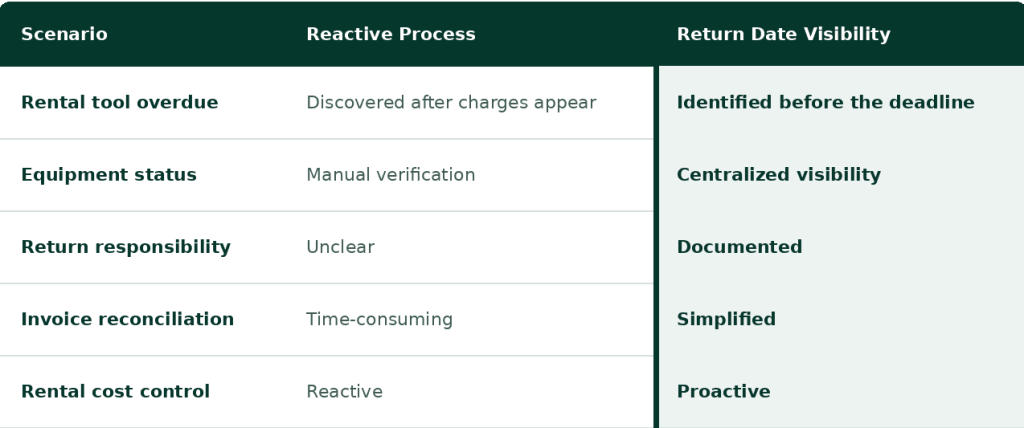
Without clear visibility into rental deadlines, contractors are forced to react instead of preventing unnecessary costs before they occur.
Most field service software solutions offer operational capabilities that help contractors to better organise their daily operations as well as improve coordination between the office and the field.
While these systems help manage people and projects, rental equipment deadlines often remain disconnected from the workflow.
Consequently, the contractors will be able to identify the areas where the crew is working, but not necessarily be aware of the location of the equipment, which should have already been brought back to the warehouse. The rental contracts are usually kept either via email, on paper, or within the accounting department and not in the same system that supports job management software.
Thus, people will be left with the necessity of remembering everything themselves.
Every rented asset comes with a financial deadline.
Return tracking is not simply an equipment management task. It is a way to protect project margins.
When return dates are visible alongside active jobs, contractors can make informed decisions before additional rental charges occur. If a project requires extra time, rental extensions can be arranged proactively. If equipment is no longer needed, crews know exactly when it should be returned.
Equipment management becomes more effective when rental activity is connected to the jobs using those assets.
In the absence of such a relationship, machinery can become one more function to be run on a call-and-text basis.
With rented equipment connected to job records, contractors get a better idea of where their assets are working and what needs to be done about them. This reduces confusion when projects overlap or equipment moves between multiple sites.
The financial impact of overdue rental charges is only part of the problem. Manual processes also create unnecessary administrative work.
The bigger the contract company is, the more difficult it becomes to maintain such a manual process. Office employees need to spend their precious time looking for paperwork, communicating with field workers, and checking if the equipment has really been returned, rather than concentrating on project execution.
The following indicators often suggest that rental equipment is creating unnecessary operational costs:
If several of these challenges sound familiar, rental equipment is likely operating outside your core workflow, making it difficult to manage efficiently as the business grows.
Rental equipment helps contractors stay flexible, but flexibility should not come at the expense of visibility. The longer rented assets operate outside everyday workflows, the harder they become to manage effectively.
When return dates, equipment locations, and job records remain connected, contractors can reduce unnecessary charges, improve accountability, and spend less time tracking down information after the fact.
Explore how Silkroad App helps contractors connect equipment tracking, inventory visibility, and field operations through a single operational workflow at the SilkRoad App.


Nelia Madeira is the Co-Founder and Chief Financial Officer (CFO) of SilkRoad Trades , a construction technology company dedicated to helping specialty contractors simplify inventory management, optimize field operations, improve job costing, and increase profitability.
With more than 20 years of hands-on experience in construction operations, accounting, office management, and business...


A return date tracker helps contractors monitor rental equipment deadlines, scheduled return dates, current locations, and job assignments so rented assets can be returned on time and unnecessary rental charges can be avoided.
Additional rental costs often occur because return dates are tracked manually, responsibility for returning equipment is unclear, or rental information exists outside the systems used to manage daily operations.
Recording the date when tools and equipment will be returned is a way of ensuring that the contractors do not incur late rental charges, among other benefits.
Contractors should track the equipment’s assigned job, current location, responsible employee or crew, rental period, scheduled return date, extension requirements, and return status.
Unexpected rental extensions, overdue charges, and additional administrative work increase project costs and reduce overall margins. Better visibility helps control these expenses before they affect profitability.
Yes. If rented equipment is associated with jobs, sites, and individuals accountable for their use, contractors will have better accountability, better documentation, and a more consistent process for managing their rental equipment from beginning to end.
Through equipment visibility, contractors will have an idea of where their rented items are, who is using them, and when they should be returned.
Contractor Software

Summary The benefits that concrete contractor software provides are best realised when it integrates all aspects of material…
Nelia Madeira
20 Nov 2026
Job Management

Summary Service business management software delivers the most value when customer management and job logistics work together without…
Nelia Madeira
13 Nov 2026
Contractor Software

Summary Trade contractors can benefit from business process automation software to automate their inventory ordering decisions to avoid…
Nelia Madeira
11 Nov 2026
Have questions or need assistance? Our team is here to help you every step of the way.
Simplify material tracking and reduce revenue leakage across your job sites.
By contacting us, you agree to your Terms of Service and Privacy Policy
Copyright © Silkroad 2026
