


How Concrete Contractor Software Helps Reduce Material Waste
Summary The benefits that concrete contractor software provides are best realised when it integrates all aspects of material…
TABLE OF CONTENTS
Trade contractors can benefit from business process automation software to automate their inventory ordering decisions to avoid the need for manual decision-making. Alerts are automatically generated if stocks fall below a certain level to ensure that the needed materials are ordered before they disrupt the planned operations. This article will look at how automated reorder points help in reducing inefficiencies in trade businesses.
Most trade contractors experience the same recurring problem. Some materials seem to run out repeatedly, while others sit untouched on warehouse shelves for months.
The issue is rarely poor forecasting. More often, it is the result of reactive inventory management.
Shortages arise only when someone decides that he/she needs the material. Purchase orders are put together late, technicians go out in emergencies to suppliers, and jobs are delayed until more stock is available. This practice arises because inventory decisions are made based on someone remembering to look at their current stock and not on a system flagging the need in time.
Over time, the practice results in a lot of unnecessary disruptions across the business. Time that could be used for work is wasted as crews wait for materials, scheduling becomes difficult, and purchases become less predictable.
The automation of business processes using automation software eliminates the reliance on memory in decision-making and makes the business run on automatic operational controls. An excellent example in this case is the inventory reorder point.
The system does not rely on human beings remembering to check their inventories but on monitoring and alerting the relevant parties before any shortages affect any ongoing projects or future projects.
For any expanding trade business, this small change can make a big difference in the consistency of operations.
The concept of automation seems daunting to many contractors, as it is perceived to be a technological project with significant modifications required to current operations.
However, automation of businesses is quite simple.
Business automation for trade involves the elimination of repetitive activities that depend on human beings to remember.
In Practice
Instead of repeatedly looking at the stock levels or checking their spreadsheets and asking if they need more supplies, contractors let the system handle that automatically for them.
This allows the owner, management, and office staff to concentrate on more important things.
Automating inventory management is the easiest area for implementation because it impacts the work performance on a daily basis. Inventory management software can help contractors monitor stock levels and respond to shortages before they disrupt operations.
The materials flow from warehouses to service vehicles to jobsites on a continual basis. With growth in business, it becomes difficult to keep track of all common materials manually.
By automating inventory tracking, consistency in the operations process can be achieved without altering any process flows.
Rather than responding to any shortage situation, contractors get advance notice to take action beforehand.
Among all automation opportunities available to trade contractors, automated reorder points often deliver some of the quickest operational improvements.
A large number of construction companies and service firms depend on a small number of products daily. This list includes fasteners, electrical supplies, plumbing items, fittings, adhesives, and repair parts, which go out and come into inventory very often.
These materials being used daily make them run out the fastest.
As there is no established level at which re-orders will be initiated, the organisations have to depend on individuals noticing empty shelves or reporting a lack of inventory on the part of technicians.
The problem is that once it has been noticed, it is too late, and reorders are reactionary in nature.
Reordering thresholds automation eliminates the need to perform regular checks manually and assists in ensuring that contractors have all the required materials available before the shortage impacts their schedule or the project itself.
Instead of asking whether the inventory needs to be reordered, it becomes clear when it actually needs to be done.
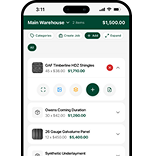
SilkRoad App uses threshold-based alerts to help contractors stay ahead of inventory shortages without relying on manual stock checks.
Instead of discovering missing materials when technicians are already on-site, contractors receive advance notice that inventory needs attention.
For example, if a commonly used plumbing fitting or electrical connector reaches its minimum stock level, the system immediately alerts the appropriate team member. Purchasing decisions can then be made before the material becomes unavailable for upcoming jobs.
This shifts inventory management from a reactive process to a proactive one, helping contractors maintain reliable stock levels while avoiding unnecessary interruptions to daily operations.
Inventory automation becomes even more valuable when it is connected to estimating and job planning rather than operating as a separate process.
Higher visibility will allow contractors to detect the risks involved before they affect scheduling.
If the estimates contain materials that are scarce or have already been dedicated to other projects, the company can order the materials prior to taking on more projects and dispatching technicians.
The chances of having promised work fail to commence due to lack of inventory are reduced significantly.
Rather than realising the lack of materials once the technicians are out of the office, contractors will have access to the data they need.
Automating inventory reorder points produces benefits that extend well beyond stock management.
When inventory remains available for planned work, technicians spend less time waiting for deliveries or making supplier trips. Office staff also spend less time checking stock manually or responding to urgent purchasing requests.
Over time, these operational improvements create more reliable project delivery while reducing unnecessary costs associated with reactive inventory management.
Automation ensures that owners of businesses have better stability in operations without necessarily having to supervise them.
They do not need to keep a personal check on their inventory or have to remind their staff about doing an inventory check, as automated alerts will notify them when anything needs to be done.
This way, they can focus on developing their business.
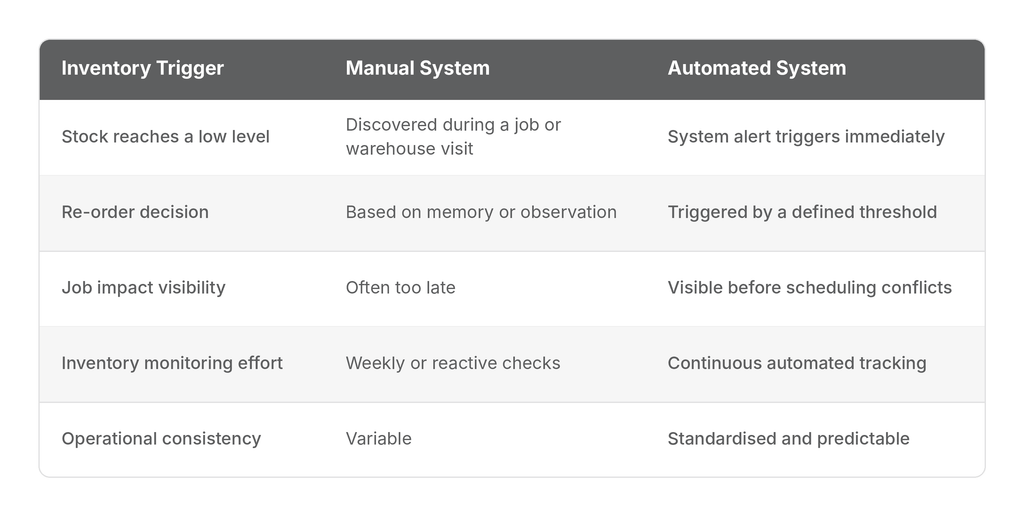
A reordering point is perhaps one of the useful forms of automation available to trade contractors. Without having to depend on their own memory or stock counts, businesses can put into place automated inventory controls that ensure their materials remain available before they become a problem.
With the use of business process automation software to integrate inventory management with estimating, procurement, and project planning, contractors spend less time reacting to inventory problems and more time doing profitable work.
SilkRoad enables contractors to automate their inventory re-orders, increase visibility, and link their business processes using just one operational workflow built for expanding trade contractors.
What is business process automation software for trade contractors?
Business process automation software assists trade contractors in automating their repetitive processes, including inventory tracking, purchase reminders, scheduling, and workflows, thereby minimising labour costs and ensuring consistency.
What is a reorder point?
The reorder point refers to an existing level of inventory that triggers a warning when the inventory level drops below a certain limit.
How do low stock warnings help prevent job delays?
Low stock warnings inform the managers about potential shortages before the job gets affected, allowing ample time for reordering materials.
Can Automation be Used to Cut Manual Inventory Management?
Yes, because automation in monitoring stock keeps track of stock all the time and sends reminders when something should be done, thus cutting down on manual labour in inventory management.
What operations can be automated by trade companies?
Trade companies can automate inventory management, reorder reminders, workflow estimation, scheduling, buying reminders, job tracking, and many other routine operational tasks which usually require manual intervention.
How does inventory automation help in reliable scheduling?
By detecting the shortage in inventory prior to job scheduling, automation helps construction companies make sure that the material will be available when the crew gets there.
Is reorder point automation useful for small contractors?
Of course, because small trade companies can also benefit from automated reorder points, since they save time, increase inventory accuracy, cut down on emergencies in buying, and bring regularity in the process.


Nelia Madeira is the Co-Founder and Chief Financial Officer (CFO) of SilkRoad Trades , a construction technology company dedicated to helping specialty contractors simplify inventory management, optimize field operations, improve job costing, and increase profitability.
With more than 20 years of hands-on experience in construction operations, accounting, office management, and business...
Contractor Software

Summary The benefits that concrete contractor software provides are best realised when it integrates all aspects of material…
Nelia Madeira
20 Nov 2026
Job Management

Summary Service business management software delivers the most value when customer management and job logistics work together without…
Nelia Madeira
13 Nov 2026
Roofing Contractor

It is common for roofing contractors to handle inventory at warehouses, in trucks, and on jobsites at the…
Nelia Madeira
09 Nov 2026
Have questions or need assistance? Our team is here to help you every step of the way.
Simplify material tracking and reduce revenue leakage across your job sites.
By contacting us, you agree to your Terms of Service and Privacy Policy
Copyright © Silkroad 2026
