



How Concrete Contractor Software Helps Reduce Material Waste
Summary The benefits that concrete contractor software provides are best realised when it integrates all aspects of material…
TABLE OF CONTENTS
Service business management software delivers the most value when customer management and job logistics work together without being merged into the same record. Customer relationships involve visibility, but operations involve execution. The following article will shed light on how segregating the two leads to better-quality data, more efficient processes, and increased visibility.
In many instances, there is an application where customer data is managed. There is also an app where scheduling is done. Invoices are managed elsewhere, and job photos are in text messages or on personal devices. When customers enquire about the state of affairs regarding a job or services, employees have to look around in various applications before they get relevant information.
This issue is not due to a lack of information but rather how the information is managed. Customer history and the process of executing jobs are often scattered and unstructured. This causes problems when companies try to expand their services or products. They become inefficient in what they do because of duplication and slow processing.
This is why service business management software is superior to other software, such as customer management or scheduling. When customer management and the process of executing a job are separate but connected, businesses get to see both customer information and processes involved in doing the job.
Customer management focuses on the long-term relationship rather than any individual job.
Every customer relationship extends beyond a single service appointment. A business client may have several buildings, regular visits for maintenance, demands for emergency services, and even years of previous work.
By organising this information, the office staff is able to learn about the background of the client right away, without having to go through tens of closed work orders.
In case of organised records, the staff will be able to give answers to the following questions right away:
This saves time and creates a more coherent experience for the customers. The employees will not need to look for information all the time but can rather use their time to assist the customers.
It is also important for the customer profile to be well-written because it brings consistency in the business. This means that even if other office employees or technicians carry out future tasks, they will be conversant with the history of the client.
While customer management focuses on the relationship, job logistics focuses on completing specific work efficiently.
Every service job generates operational information that is only relevant to that particular visit.
A crew assignment, arrival time, job site photographs, materials employed, equipment allocation, and completion notes help achieve a successful job. Once the job is completed, these will be included in the project documentation, not in the client’s information. This distinction ensures that everything is kept neat.
Technicians can quickly access everything needed to complete today’s work, while office staff can review customer history without sorting through large amounts of job-specific data.
This structure also makes daily operations more efficient. Dispatchers can look at schedules, allocate crews, track progress, and read site notes without having to go through customer communications that have nothing to do with what they are actually working on.
The more service companies have to manage technicians, customers, and jobs that they are doing, the more streamlined, searchable, and ultimately scalable their process will be by keeping these separate.
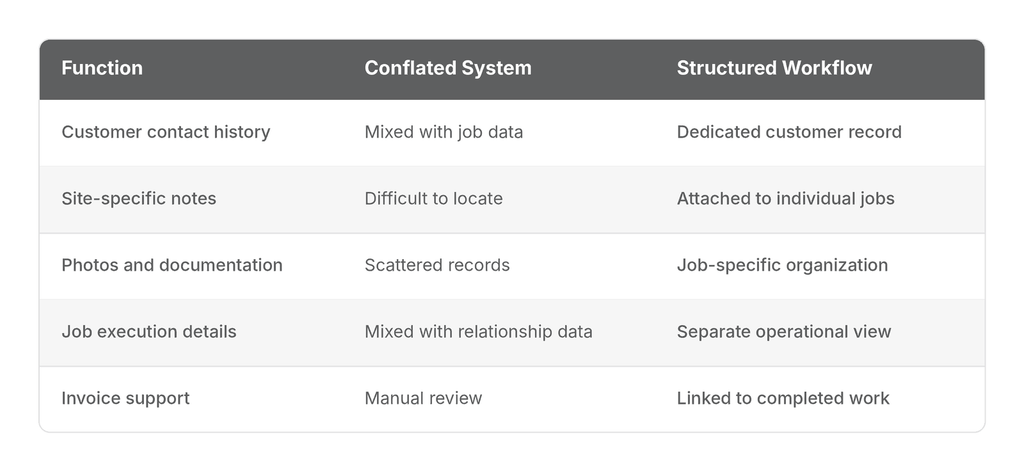
Many service businesses store customer information and job details inside the same record. While this may seem convenient initially, it becomes increasingly difficult to manage as the business grows.
Managers have to search for information more than implement it.
For instance, information provided by the technician on a repair carried out a week ago may be filed together with customer correspondence and invoices stretching back over many years. Searching for just one detail turns out to be a problem.
This approach also creates unnecessary duplication. Customer information is frequently duplicated into new jobs, whereas repeated site information is manually entered rather than referred to from the previous record. Over time, duplication creates the problem of out-of-date and contradictory data.
In cases where the customer relations and the operational processes are kept separately but linked, both teams have the required access to information without sifting through unnecessary records.
Customer management and job logistics should work together without becoming the same thing.
This structure allows office staff, technicians, and managers to view either the customer relationship or an individual job without losing important context.
For example, a dispatcher scheduling today’s service call only needs access to today’s work order, assigned crew, site notes, and schedule. Meanwhile, the office team handling a customer enquiry may need previous communication history, multiple service locations, and historical jobs.
Both parties work with related information, but neither of them is forced to sort out irrelevant information.
As businesses get bigger, this distinction becomes increasingly important since there are hundreds, perhaps thousands, of finished tasks that have been filed according to the right client.
Organised records improve nearly every aspect of a service business.
When information is stored in the right place, teams spend less time searching for data and more time completing productive work.
Schedulers can assign jobs faster because site information is already available. Technicians arrive with complete job details instead of calling the office for clarification. Customer support can answer questions immediately without opening multiple systems.
Owners also gain better operational visibility. They don’t have to gather data from various spreadsheets, emails, and software programs, but they can see the activities of the customers, active projects, finished work, and performance of operations in an integrated workflow.
Structured data helps in generating more reliable reports, thereby making the assessment of workloads, customer history, and performance of operations easy.
Manage Relationships Without Losing Operational Control
Growing service organisations require transparency in regard to both customers and jobs, but they have different functions.
The combination of customer management and job logistics while maintaining their separation ensures cleaner information flows, smoother processes, and greater transparency for organisations. This way, employees save time on finding necessary information, managers feel more confident when making their decisions, and customers benefit from an improved service experience.
SilkRoad App allows service organisations to integrate customer history, job management, inventory visibility, and workflows into one solution.
What is service business management software?
Service business management software allows organisations to effectively organise customer details, schedules, task management, fieldwork, billing, and workflows all through one integrated system.
Why should customer management and job logistics remain separate?
Customer management deals with relationships over time; task logistics relate to the performance of individual tasks. It is wise to keep these records separate for a number of reasons.
What should go into a customer profile?
Customer profiles typically include contact information, multiple service locations, communication history, customer notes, documents, and historical job records that support the overall relationship.
What information belongs in a job record?
Records for jobs include operational details such as scheduling information, assignment of crew members, site-related details, pictures of the job, record of inventory transactions, progress made on the job, and records related to this particular project.
What are the advantages of structured data for operations visibility?
Structured data enables quick access to data by employees, eliminates duplicates, facilitates reporting, and ensures that there is more visibility when it comes to managing relationships and operations.
What prevents service companies from having fragmented information?
Companies often use different systems for their scheduling process, customer records, invoicing, and communication with customers out in the field.
How do connected records help to enhance customer service and invoicing?
Connected records make sure that the customer information, completed work, and job records remain connected but not confused with each other.


Nelia Madeira is the Co-Founder and Chief Financial Officer (CFO) of SilkRoad Trades , a construction technology company dedicated to helping specialty contractors simplify inventory management, optimize field operations, improve job costing, and increase profitability.
With more than 20 years of hands-on experience in construction operations, accounting, office management, and business...
Contractor Software

Summary The benefits that concrete contractor software provides are best realised when it integrates all aspects of material…
Nelia Madeira
20 Nov 2026
Contractor Software

Summary Trade contractors can benefit from business process automation software to automate their inventory ordering decisions to avoid…
Nelia Madeira
11 Nov 2026
Roofing Contractor

It is common for roofing contractors to handle inventory at warehouses, in trucks, and on jobsites at the…
Nelia Madeira
09 Nov 2026
Have questions or need assistance? Our team is here to help you every step of the way.
Simplify material tracking and reduce revenue leakage across your job sites.
By contacting us, you agree to your Terms of Service and Privacy Policy
Copyright © Silkroad 2026
