


How Concrete Contractor Software Helps Reduce Material Waste
Summary The benefits that concrete contractor software provides are best realised when it integrates all aspects of material…
TABLE OF CONTENTS
Handyman software solutions’ value will be seen when the process of handling work, from estimating to executing the job, managing inventory, and invoicing, is minimised. The process becomes efficient when there is automatic conversion of estimates into actual work, and updates are done on inventory during the job process. The result will be less time spent recreating records and more time spent doing billable work.
For many handyman and small repair companies, performing the job is usually the easy part of their day. However, the hard work starts afterwards.
Materials have been taken out of the truck; the client asks for additional work at the moment of the visit; several service calls have been made until lunchtime, and now it is time to make the invoices. Unfortunately, the necessary data can be found everywhere: in the job photos, in text messages, and on paper.
Consequently, this is what happens: the invoices are made more slowly, some materials remain unrecorded on the invoice, and inventory management becomes less efficient each time a job is performed.
With an increasing number of service calls per day, such minor inefficiencies start having an effect on profitability and service quality. Instead of thinking about their next service call, the contractors have to spend time making sense of work that was done already.
Automation of the process from estimate approval to inventory deduction is one of the biggest advantages of modern handyman software solutions.
Most invoicing problems do not begin when the invoice is created. They start much earlier in the workflow.
A typical scenario would be where the customer agrees to an estimate, but a job has to be created, customer information entered manually again, scheduling done, and a material list reconstructed before the technicians can start working.
Other tasks can come up in the course of the day, like using replacement parts or taking other materials from the service vehicle. Failure to capture this information at the point of occurrence will lead to forgetting this information when moving to the next task.
By the end of the day, the invoice depends more on memory than on documented work.
The issue is rarely the invoice itself. It is the missing workflow that connects the approved estimate to the completed job. When each step operates independently, important information is lost from one step to another, making it more difficult and inaccurate to complete billing.
The approval of an estimate should automatically launch the next phase of work, without forcing the office workers to do repetitive paperwork.
With handyman software solutions, contractors can continue working from the same project record instead of recreating information already collected during estimating.
Customer details, approved pricing, scope of work, and scheduling information remain connected as the project moves from estimation into execution. This reduces duplicate data entry while ensuring everyone works from the same information.
It is not only about saving time on administration but also making sure that all vital information is considered prior to starting the project. With many more tasks being performed by the company on a daily basis, this little extra time becomes very important for focusing on clients rather than documents.
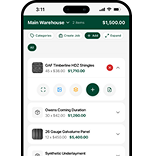
Many handymen complete several jobs every day using materials managed through inventory management software, with stock stored in their service vehicles rather than a central warehouse. While this approach keeps crews mobile, it also makes inventory much harder to track accurately.
The lack of visibility with the inventory often results in the contractors recognising the problem only when they have arrived at the site. The fitting or the fastener that was used in the first call is still showing as available, although it is already utilized.
As the number of daily service calls increases, inventory visibility becomes increasingly valuable. Understanding what materials are left over before heading out to the next appointment will allow contractors to avoid additional trips to suppliers, schedule interruptions, and more effective working hours in a day.
Many handyman businesses complete several small projects within a single day, making organisation just as important as technical skill.
The lack of a centralised system makes it easy for technicians to forget what was said and done by jotting down information in handwritten notes, sending messages, and remembering everything in their minds.
The fact that all the tasks can be linked together means that contractors can easily move from one task to another, seeing all information regarding schedules, inventory, clients, and completed jobs.
Accurate invoicing starts with complete job records, and handyman software solutions help preserve those records throughout the job lifecycle rather than forcing contractors to reconstruct work afterward.
When technicians document work as it happens, invoicing software for contractors can make invoice creation far more efficient. The material costs are already linked to the job; the work done is accounted for, and supporting documents can easily be accessed in case there are any doubts in the future.
In place of remembering all the details towards the end of the day, contractors can create an invoice through proper collection of data during the entire process of the service.
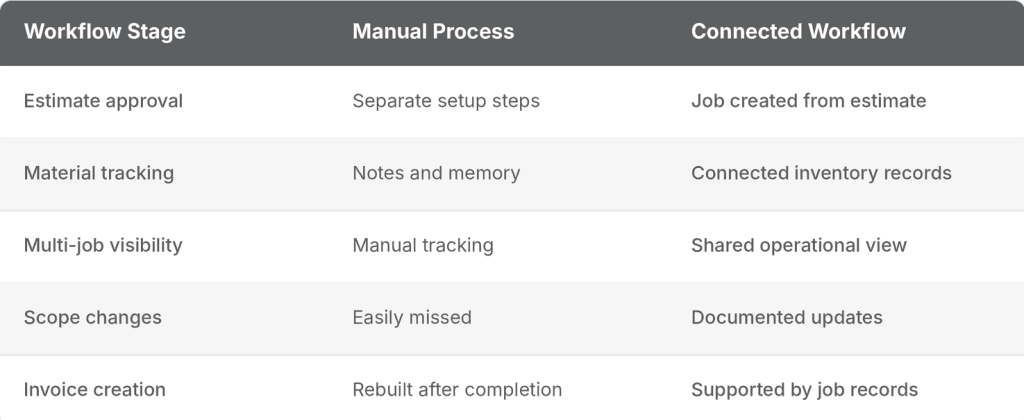
Handyman firms do their best if administration is kept behind the scenes while operations take centre stage.
Linking estimate approvals, the completion of work, the accounting of inventory, and billing into one process avoids duplication and increases accuracy at each step in the process.
In growing firms, handyman software solutions can assist in eliminating the manual transition from estimates to work, inventory, and billing. Contractors gain better visibility into completed work, spend less time rebuilding records, and create invoices with greater confidence.
SilkRoad App helps contractors connect estimating, inventory visibility, job management, and documentation through a single operational platform built for growing service businesses.


Nelia Madeira is the Co-Founder and Chief Financial Officer (CFO) of SilkRoad Trades , a construction technology company dedicated to helping specialty contractors simplify inventory management, optimize field operations, improve job costing, and increase profitability.
With more than 20 years of hands-on experience in construction operations, accounting, office management, and business...


Handyman software solutions automate the process of transforming an approved estimate into a job, linking scheduling, inventory management, document control, and invoicing in one flow.
When invoices rely on memory instead of documented job records, material charges, additional work, and scope changes are more likely to be missed, reducing overall profitability.
Automatically converting approved estimates into active jobs eliminates duplicate data entry, keeps customer information connected, and reduces administrative work before the project begins.
By recording material usage as work progresses and connecting inventory to each job, contractors gain better visibility into available stock and avoid duplicate material allocations.
A complete job record should include customer information, completed work details, material usage, site notes, photos, scheduling information, and any documented scope changes.
Automation of processes passes information from estimation to job completion, thus helping generate invoices based on accurate information rather than manual data recovery following job completion.
Yes. It is possible to make even small businesses save effort on administration, increase the accuracy of inventory management, speed up invoicing, and build uniform business processes through automation of repetitive workflow steps.
Contractor Software

Summary The benefits that concrete contractor software provides are best realised when it integrates all aspects of material…
Nelia Madeira
20 Nov 2026
Job Management

Summary Service business management software delivers the most value when customer management and job logistics work together without…
Nelia Madeira
13 Nov 2026
Contractor Software

Summary Trade contractors can benefit from business process automation software to automate their inventory ordering decisions to avoid…
Nelia Madeira
11 Nov 2026
Have questions or need assistance? Our team is here to help you every step of the way.
Simplify material tracking and reduce revenue leakage across your job sites.
By contacting us, you agree to your Terms of Service and Privacy Policy
Copyright © Silkroad 2026
