



How Concrete Contractor Software Helps Reduce Material Waste
Summary The benefits that concrete contractor software provides are best realised when it integrates all aspects of material…
TABLE OF CONTENTS
Construction project management software enables contractors to manage schedules, budgets, project documents, and milestones effectively. Some construction project management software fails to offer real-time material tracking capabilities. Failure to incorporate project planning and material availability often leads to delays, double orders, and budget overruns. Real-time material tracking offers a way for contractors to base their decision-making on the material availability at the moment.
Projects in construction are usually very organised before construction even starts. The schedule and budgets are set, the subcontractors are determined, and everything else about the project seems to fall into place.
Then comes the next step, and the team finds out that key supplies are not available. Some have already been earmarked for use elsewhere, some haven’t been ordered again, and others are just being delivered. It becomes apparent that the schedule that had been set will no longer stick to the plan.
The issue is rarely poor planning. More common is decision-making without visibility of inventory at the moment.
Materials are just as critical for construction projects as timeframes. But inventories are usually managed using standalone systems, spreadsheets, or other methods that are not integrated with the project. The result is an operational disconnect where plans of the project assume how things should be done, not how they could be done.
As construction companies develop and run more and more projects, this disconnect becomes too costly. Integration of project planning and inventory management will make it possible for contractors to know about material availability before mobilization of crews.
Construction project management software that is currently available has proved to be very important in managing complex construction projects. The system integrates several features of project implementation into a workflow process that makes everything more visible.
Construction projects involve hundreds of moving parts that must remain coordinated throughout the project lifecycle. Project management platforms help contractors organise work, communicate expectations, assign responsibilities, and monitor progress against planned timelines.
Managers can track project milestones, monitor budgets, store drawings and documents, and coordinate office and field teams from a central platform. These capabilities improve organisation while reducing many of the communication challenges associated with complex construction work.
The limitation begins when material availability exists outside that planning environment.
The project schedule might show that the task of building frames, roofs, or finishing should start next week, but without inventory visibility tied to these plans, the contractors will not be able to tell whether the materials for this purpose are available.
Project management software tracks what is planned.
Inventory visibility shows what is possible.
When these two operational areas remain disconnected, construction businesses often discover problems only after work has already been affected.
Material shortages rarely appear without warning. In many cases, the information already exists somewhere within the business, but it is not available where project decisions are being made.
For instance, the project manager might authorise the next stage of construction based on the assumption that enough materials would be available. However, upon further investigation, it is found that the very same materials were assigned to some other ongoing project. The delay causes further scheduling changes, idle labour, and rush procurement, which could have been avoided through proper inventory management software.
If inventory management and project planning work independently, operational issues tend to occur much more often. Rather than proactively managing their projects, contractors find themselves reacting to the problems.
Inventory affects almost every decision made throughout a construction project. Whereas schedules provide for when work is supposed to take place, inventory provides the answer as to whether that work can indeed get started as planned.
Without having access to live inventory data, project managers frequently base their decisions on out-of-date information. This leads to shortages of materials, duplicate orders, and unnecessary delays.
The project manager now gets to know a lot more about the current inventory that they have at hand, the resources that have been committed to other projects, and the items that need to be addressed prior to the next phase.
This level of visibility helps with cooperation and coordination among project managers, procurement teams, warehouse managers, and field managers. They all get to see things from one single perspective.
Project visibility improves significantly when inventory information follows the workflow from estimating through project execution instead of existing in isolation.
In the estimation process, contractor estimating software can help incorporate material needs from the outset, allowing contractors to plan their inventory sooner in the cycle. During the course of the project, the material remains linked to the project in question; therefore, it is easier to know what has been budgeted, what has been used, and what is left.
This streamlines the process by eliminating double entry of data and providing more assurance that the project information matches reality.
Instead of rebuilding records at every stage, contractors work from one continuous flow of information that links estimating, inventory planning, job execution, and project management.
Live inventory visibility is only valuable when inventory records accurately reflect what is physically available.
Materials move constantly throughout construction projects. They are delivered to sites, transferred between locations, consumed during work, or returned to storage. Without regular verification, inventory records gradually become less reliable.
Regular inventory audits enable contractors to detect discrepancies before they impact project timetables.
For instance, during the auditing process, one may find out that the inventory that is listed as having been put aside for a certain project had actually been used in a different project, was damaged, or had been moved without proper records.
This helps the project managers to make the right scheduling decisions without any problems. Rather than ordering replacement materials unnecessarily, contractors can purchase only what is genuinely required while making better use of existing inventory across multiple projects.
Good inventory visibility starts with accurate inventory records, and regular audits help ensure that visibility remains reliable throughout the entire project lifecycle.
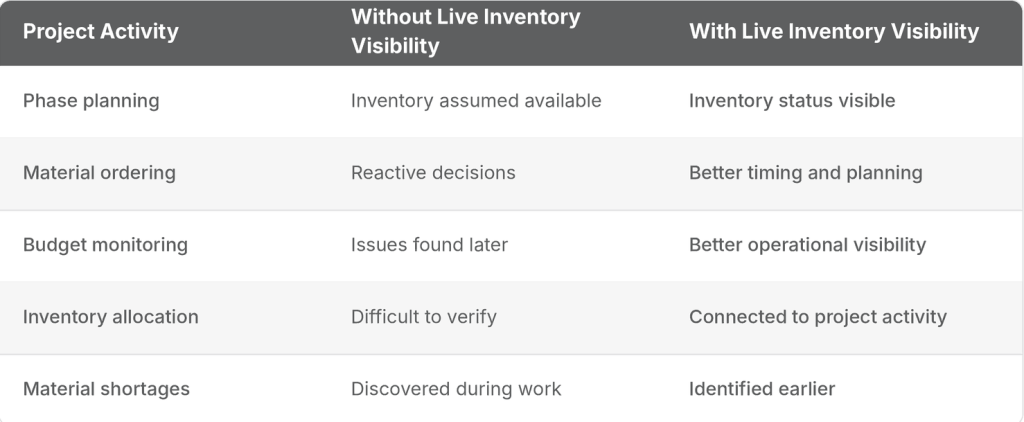
Effective construction projects rely on a lot more than just organised schedules and good budgeting practices. The effective availability of the required materials at each stage of the construction is also important.
In construction project management software that has access to real-time inventory visibility, the contractor is able to have a better sense of how ready their projects are, make better procurement decisions, avoid unnecessary lags, and generally make better operational decisions along the way.
Rather than waiting to react to problems with the lack of material after the work comes to a standstill, contractors can anticipate problems, coordinate better across departments, and carry out projects more confidently.
SilkRoad App connects the dots of inventory visibility, project execution, job tracking, and operational flows in one unified system suitable for expanding construction firms.


Nelia Madeira is the Co-Founder and Chief Financial Officer (CFO) of SilkRoad Trades , a construction technology company dedicated to helping specialty contractors simplify inventory management, optimize field operations, improve job costing, and increase profitability.
With more than 20 years of hands-on experience in construction operations, accounting, office management, and business...


Construction project management software encompasses such aspects as planning, scheduling, budgeting, documenting, and coordinating, whereas inventory tracking software gives visibility about availability, movement, allocation, and quantity of materials.
Delays often happen due to the absence of necessary materials. This can be caused by the fact that the materials are allocated for other projects, the purchase of materials was delayed, there is no accurate data about materials available, or the contractor cannot see his inventory before starting the project.
With live inventory visibility, project managers can verify availability before planning the jobs, spot any shortages, make better plans for procurement, and minimise disruptions that may be caused due to unforeseen shortages in the inventory.
Inventory allocation is the process of assigning specific materials to individual projects or project phases before they are used. This enables contractors to avoid duplication and improve their planning capabilities.
Contractors will be able to enhance forecasting through monitoring inventory trends, reviewing upcoming project needs, assessing committed inventory, and keeping proper records of inventory through regular audits.
Inventory auditing is done to ensure that the recorded inventory is equal to the actual inventory. This ensures better procurement, avoids shortage surprises, enhances forecasts, and gives more certainty in planning future project operations.
Yes, combining project management and real-time inventory visibility enables contractors to plan, budget, manage materials, allocate inventories, and execute projects in one operational process.
Contractor Software

Summary The benefits that concrete contractor software provides are best realised when it integrates all aspects of material…
Nelia Madeira
20 Nov 2026
Job Management

Summary Service business management software delivers the most value when customer management and job logistics work together without…
Nelia Madeira
13 Nov 2026
Contractor Software

Summary Trade contractors can benefit from business process automation software to automate their inventory ordering decisions to avoid…
Nelia Madeira
11 Nov 2026
Have questions or need assistance? Our team is here to help you every step of the way.
Simplify material tracking and reduce revenue leakage across your job sites.
By contacting us, you agree to your Terms of Service and Privacy Policy
Copyright © Silkroad 2026
