


How Concrete Contractor Software Helps Reduce Material Waste
Summary The benefits that concrete contractor software provides are best realised when it integrates all aspects of material…
TABLE OF CONTENTS
Mobile dispatch software assists small companies in route optimisation, crew scheduling, and management of daily scheduling. But even when companies are able to optimise their route planning, it is not enough for job success. If dispatching and inventory availability are not connected, then the crew will arrive at the destination without the necessary supplies for completing the job. This article will examine how balancing route efficiency and inventory availability can contribute to job success.
The dispatcher kicks off the day with the allocation of two jobs located on the same side of town. There is an available technician, good travel arrangements, and the schedule for the day seems well-organised.
The first job is completed according to the plan. At the second job, the technician finds out that an important part required for replacing the defective component is not present in the company’s vehicle. Work comes to a halt as the crew communicates with the office and searches for more parts.
The route was efficient.
The outcome was not.
In case of a lot of maturing service companies, dispatcher decisions are mostly determined by technician availability, distance, and efficient scheduling. Whether the inventory is available gets confirmed only upon arrival of the technician on the site, which implies that rectifying the issue will have become expensive.
With rising workloads, this gap tends to be increasingly obvious. While a company could have managed its scheduling efficiently, it can still waste a lot of time due to the unavailability of inventory for the technicians’ assigned tasks.
Efficiency is more than just dispatching the nearest technician to the job.
The mobile dispatch software is useful for companies, as it will help them schedule their technicians better and cut down unnecessary travel.
The benefits of proper dispatching include saving time, better use of resources, and enabling companies to do more work within a day.
Dispatchers have the opportunity to allocate work to the closest technician, schedule around emergencies, and follow up on jobs as workers move from one place to another.
For businesses handling multiple technicians and service appointments every day, route optimisation provides measurable operational benefits.
The problem is that route optimisation addresses just one piece of the puzzle.
If a technician is early, he still won’t be able to get the job done if he doesn’t have the material on hand. Similarly, the optimised schedule becomes useless if crews have to look for stock or visit suppliers unexpectedly.
Without inventory visibility, dispatchers optimise movement but not job readiness.
Most dispatch systems know where technicians are scheduled to go.
They often do not know whether those technicians have everything required to complete the assigned work.
Consider a technician assigned to install replacement valves during the afternoon. The route is efficient, but the necessary valve was already used on a morning service call and never updated in inventory. The technician only discovers the shortage after arriving on-site.
The remaining schedule begins to unravel. Additional travel is required, future appointments run late, and customers experience delays despite careful route planning.
Even a perfectly optimised dispatch schedule cannot overcome missing inventory.
Businesses that rely only on routing efficiency often continue experiencing avoidable truck rolls, emergency purchasing, and interrupted work because stock readiness remains outside the dispatch process.
Dispatching becomes significantly more effective when inventory management software provides inventory information is considered alongside route planning. Instead of assigning work based only on technician location, dispatchers can also verify whether the required materials are available before the crew leaves.
As a result, when the dispatchers know the real-time inventory, they will be able to schedule their work in a confident manner. Specialised jobs can be allotted only after verifying the availability of the required stock, while jobs that require material can be allocated at another time instead of disturbing the entire day’s schedule.
This method not only saves unnecessary distractions but also assists the technician in performing his job without any hindrances.
Many small service businesses store inventory across several locations rather than a single warehouse.
The closest technician is not always the best technician to assign.
Even if the technician is just minutes away from the customer, if the equipment that he needs to do his job is not available with him but rather on some other truck or in the warehouse, all that extra time that was gained in terms of scheduling goes out the window.
Knowing where the equipment is will help the dispatcher plan the schedule in such a way that it considers both travel time and equipment availability.
This creates a more accurate picture of operational capacity while reducing unnecessary supplier trips and midday schedule changes.
Effective dispatch planning does not end once a technician arrives on-site. Information collected during the job helps improve decisions for the remainder of the day.
Since the data regarding the usage of materials and the progress made by technicians is updated continuously, the inventory data remains accurate throughout the day.
Should there be a need for extra parts, the dispatchers will be able to know how that will affect the other upcoming jobs and schedule those accordingly. If work gets done sooner or materials are left unused, that could also help in assigning future tasks.
In linking the field data to dispatch scheduling, the constant stream of data is ensured rather than waiting for phone calls or notes at the end of the day.
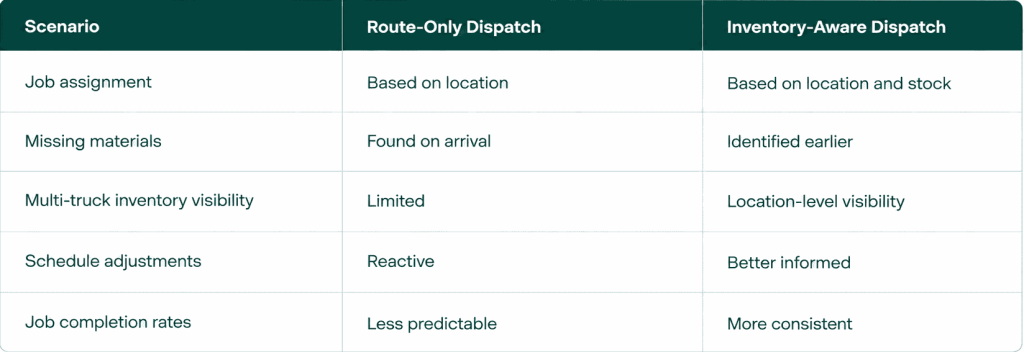
The most successful dispatch operation is the one that always dispatches technicians who are always ready for the job.
With mobile dispatch software complemented with inventory visibility, companies will be able to make better schedule decisions, minimise truck roll costs, increase technician efficiency, and offer improved customer experience.
Through integration of dispatching, inventory management, scheduling, and field services in one workflow, contractors will have more control over their operations without experiencing disruption caused by material shortages.
SilkRoad App assists contractors in integrating dispatching, inventory management, scheduling, and field services in one workflow.


Nelia Madeira is the Co-Founder and Chief Financial Officer (CFO) of SilkRoad Trades , a construction technology company dedicated to helping specialty contractors simplify inventory management, optimize field operations, improve job costing, and increase profitability.
With more than 20 years of hands-on experience in construction operations, accounting, office management, and business...


Mobile dispatch software enables businesses to plan technician schedules, optimise routes of travel, assign jobs, and manage crew availability through a single platform.
No matter how well the schedule is planned, it will not be effective if the technicians do not have all necessary inventory at hand. The lack of inventory means more trips to the supplier, delayed jobs, disrupted schedules, and decreased efficiency.
Inventory visibility makes it possible for the dispatcher to check the availability of the inventory before scheduling and to schedule the jobs considering not only the location of the technician but also the job preparedness.
Multi-location inventory tracking provides businesses with visibility about materials available in the warehouse, service trucks, storage locations, and job locations, making it easy to find out inventory and schedule jobs.
Businesses can reduce unnecessary truck rolls by confirming inventory availability before dispatch, keeping inventory records updated throughout the day, and assigning technicians who have both the required materials and the right location.
Stock availability is what determines whether tasks can be done on the first visit. Taking into account stock while dispatching will definitely increase completion rates, cut down delays, and avoid multiple trips.
Yes, combining dispatch software and inventory management allows businesses to link all the above elements into one operational flow.
Contractor Software

Summary The benefits that concrete contractor software provides are best realised when it integrates all aspects of material…
Nelia Madeira
20 Nov 2026
Job Management

Summary Service business management software delivers the most value when customer management and job logistics work together without…
Nelia Madeira
13 Nov 2026
Contractor Software

Summary Trade contractors can benefit from business process automation software to automate their inventory ordering decisions to avoid…
Nelia Madeira
11 Nov 2026
Have questions or need assistance? Our team is here to help you every step of the way.
Simplify material tracking and reduce revenue leakage across your job sites.
By contacting us, you agree to your Terms of Service and Privacy Policy
Copyright © Silkroad 2026
