



Service Business Management Software: Separating Customer Management from Job Logistics
Summary Service business management software delivers the most value when customer management and job logistics work together without…
TABLE OF CONTENTS
The benefits that concrete contractor software provides are best realised when it integrates all aspects of material ordering, project management, and material flow into one process. Comparing the estimates to the actual amount of material used helps in pinpointing the area where waste is generated so as to inform better estimating practices going forward. In concrete construction, which involves material ordering before the start of the project, job level makes waste visible, measurable, and easier to reduce across repeated projects.
One trade in which the material planning is supposed to be very accurate from the very outset is concrete. This material requires a careful calculation of volumes, timely deliveries, and coordinated manpower for pouring the concrete. Yet despite careful planning, actual material usage rarely matches the estimate exactly.
Weather conditions can delay pours. Site preparation may not be completed on time. Design changes, revised slab depths, or unexpected ground conditions can all affect how much concrete is ultimately used. Even small variations can create additional costs when materials have already been ordered and delivered.
The challenge is not that estimates are poorly prepared. It is that many contractors lack visibility into the difference between what was planned and what actually happened on-site.
Without job tracking connected to inventory records, material variance is often absorbed as a general project expense. Unnecessary concrete, unutilised reinforcement material, or even returned materials are seldom recorded in a manner that could assist future estimates. The consequence is that the same assumption is repeated for the next project, enabling inefficiencies to persist.
The use of concrete contractor software assists in filling this void through linking estimating, inventory management, and jobs. This enables contractors not to treat each estimate and job as an individual entity but rather to correlate past estimates and jobs in order to find any trends that can affect future projects.
This leads to the creation of a functional feedback mechanism.
Concrete projects present inventory challenges that differ from many other construction trades.
Unlike general building materials that can often be returned or reused later, concrete deliveries are highly time-sensitive and must be planned before work begins.
Every concrete pour requires contractors to balance sufficient material quantities with the cost of ordering more than necessary.
An order that is too small may lead to delays due to procurement of more material, while too much ordering may lead to unused materials that cannot be retrieved. Such problems may lead to higher costs.
The decisions are made before the actual execution of the work, and therefore, contractors rely greatly on their estimation and experience.
The cost of concrete depends on volume and time.
Even minor mistakes in estimation can lead to major economic implications, especially when these mistakes keep happening in various jobs. It is difficult for contractors to know what causes the variations without any precise data at the project level.
This is the starting point for eliminating wastage of material.
Most concrete contractor software provides valuable tools for coordinating day-to-day project execution.
These capabilities help contractors organise work, coordinate teams, and keep projects progressing according to schedule.
However, material intelligence often remains disconnected from operational workflows.
Many systems record project progress without linking material usage directly to job execution.
The estimation of materials, inventory documentation, and completed works are often separate from each other, which makes it hard to compare the amount of materials estimated with the amount used.
Without such a link, the contractors are aware that the project is finished but cannot see whether the amount of materials used corresponds to their estimation.
As projects accumulate, these missed insights reduce opportunities to improve estimating accuracy and control material costs across future jobs.
Job tracking becomes far more valuable when it connects estimated material quantities to what actually happens during project execution.
Instead of treating each concrete pour as a standalone project, contractors can compare planned material requirements with actual usage and identify where differences occur.
This information provides a clearer picture of how materials move throughout the project rather than simply recording what was ordered.
When job-level data is collected consistently across multiple projects, meaningful trends begin to emerge.
Contractors may identify:
Rather than relying solely on experience, contractors can use historical job data to improve future planning decisions and reduce recurring waste.
Job tracking becomes even more effective when supported by regular inventory audits.
While job records show what materials were planned and consumed, inventory audits verify what actually returned from the field after work was completed.
These audits create a reliable reference point for future estimating.
Instead of assuming how much material was used, contractors can validate inventory movement against completed work and identify discrepancies before they become long-term inventory errors.
More accurate inventory records also improve purchasing decisions while reducing unnecessary material waste across future projects.
Material reduction does not mean that one only orders fewer materials.
It is an ongoing process whereby completion of each project aids in improving the next project.
Rather than repeating the same estimating assumptions on every project, contractors develop estimates based on actual field performance.
In such a case, this will make material ordering much better and predict project costs much better.
Past job files will not only be used for archiving but also as a decision-making tool.
Many concrete contractors manage several pours across different locations at the same time.
Keeping track of material allocation, inventory movement, and project progress becomes increasingly difficult as operations expand.
With centralised visibility, project performance can be known without having to make phone calls all the time.
There is no need to wait until the completion of projects for any materials that need addressing. Instead, they can be monitored as the project moves along.
This supports faster decision-making while improving accountability across multiple active jobs.
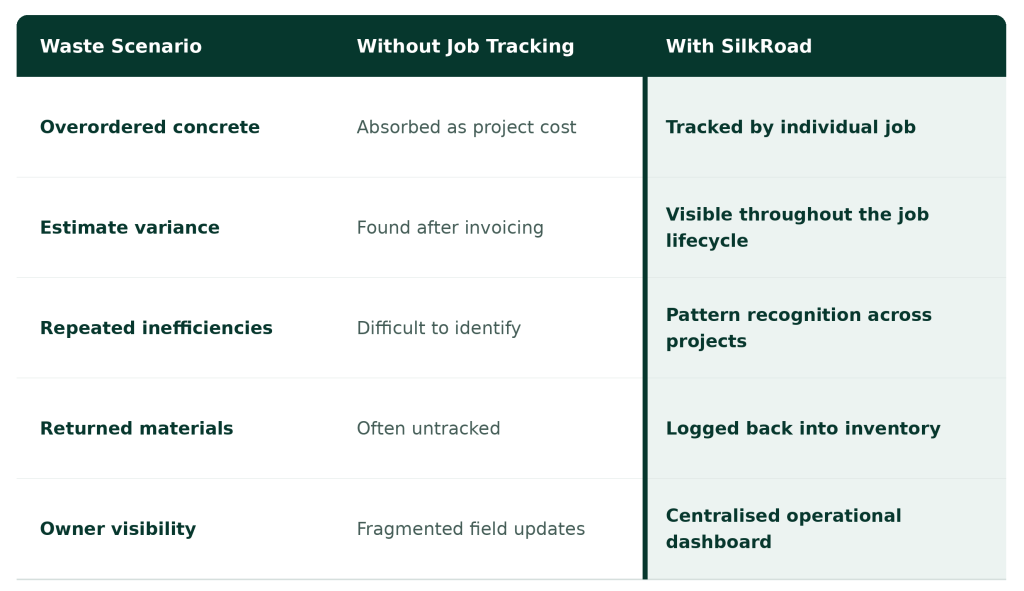
Concrete contracting waste reduction is a process that requires an understanding of the connection between estimation, job completion, and materials consumption.
When the concrete contractor software links these operational processes, the contractor gets insight into how materials are used, how the estimations differ from reality, and what areas should be improved in the future.
Rather than letting materials waste become part of the project cost, companies will be able to measure their performance for each pour, improve estimating skills, and make informed inventory decisions.
SilkRoad allows concrete contractors to link job management, inventory control, estimating, and operations within one system designed specifically for construction companies.
What is the use of concrete contractor software?
The use of concrete contractor software enables contractors to perform all their functions more efficiently, like estimates, schedules, jobs, inventory, documentation, and processes of their business.
How does job tracking reduce material waste in concrete projects?
The practice of job tracking involves comparing estimated quantities of material to the actual amounts used in construction projects, enabling contractors to spot patterns of waste, enhance estimation abilities, and avoid unnecessary orders of materials.
Why is it so common for concrete to be overordered?
Concrete needs to be ordered before construction even starts, and since conditions on-site may change, contractors usually place more orders as a buffer. But without any historical usage information, these buffers may grow quite large.
How do contractors compare estimated and actual usage of material?
Using the estimating information, inventory reductions, job completion information, and returned materials, contractors are able to compare estimated quantities and actual usage for each of the jobs performed.
What part do inventory audits play in concrete contracting?
Audits allow contractors to confirm returned material, reconcile stocks, find inconsistencies, and increase the precision of future estimations.
Can job tracking improve estimating accuracy over time?
Yes. Job monitoring consistently allows for performance data from the past that can assist in making future projections, identifying material variances that reoccur, and eliminating waste in similar projects.
What are ways that small concrete contractors can reduce operational waste?
Small contractors can eliminate waste through job-level monitoring of materials, regular auditing of materials, returning materials, and analysing past projects.


Nelia Madeira is the Co-Founder and Chief Financial Officer (CFO) of SilkRoad Trades , a construction technology company dedicated to helping specialty contractors simplify inventory management, optimize field operations, improve job costing, and increase profitability.
With more than 20 years of hands-on experience in construction operations, accounting, office management, and business...
Job Management

Summary Service business management software delivers the most value when customer management and job logistics work together without…
Nelia Madeira
13 Nov 2026
Contractor Software

Summary Trade contractors can benefit from business process automation software to automate their inventory ordering decisions to avoid…
Nelia Madeira
11 Nov 2026
Roofing Contractor

It is common for roofing contractors to handle inventory at warehouses, in trucks, and on jobsites at the…
Nelia Madeira
09 Nov 2026
Have questions or need assistance? Our team is here to help you every step of the way.
Simplify material tracking and reduce revenue leakage across your job sites.
By contacting us, you agree to your Terms of Service and Privacy Policy
Copyright © Silkroad 2026
